Trastevere and Environs
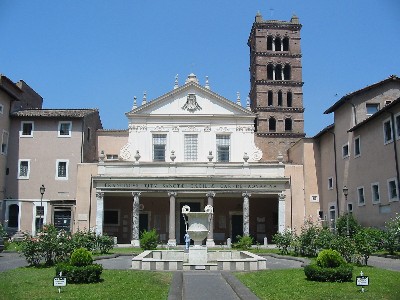 While
most of Rome sank into the grime and neglect of the Middle Ages,
Trastevere and the part of town facing it on the other side of the
Tiber flourished in the late 13th and early 14th centuries. This
occurred thanks to the aristocratic Stefaneschi family that dominated
local politics and lavished these two quarters with their support.
Under the family’s auspices, "their" churches were embellished by
several bright artistic lights: Pietro Cavallini, Arnolfo di Cambio,
and the so-called Cosmati family, who embroidered magnificent
polychrome marble tapestry. While
most of Rome sank into the grime and neglect of the Middle Ages,
Trastevere and the part of town facing it on the other side of the
Tiber flourished in the late 13th and early 14th centuries. This
occurred thanks to the aristocratic Stefaneschi family that dominated
local politics and lavished these two quarters with their support.
Under the family’s auspices, "their" churches were embellished by
several bright artistic lights: Pietro Cavallini, Arnolfo di Cambio,
and the so-called Cosmati family, who embroidered magnificent
polychrome marble tapestry.
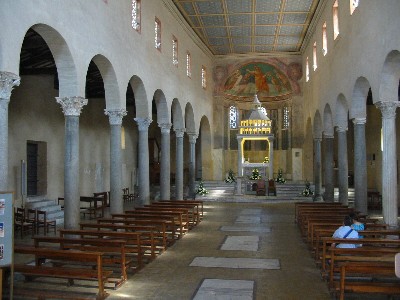
We start at the solitary church of San Giorgio, discussing both the
eponymous saint and the history of the church. Although the fresco in
the apse is badly damaged, it deserves our consideration in order to
glean insight into the career of the artist, Pietro Cavallini, and the
Stefaneschi family’s dedication to him.
From here we move on to Santa Maria in Cosmedin. Described as the most intact Medieval
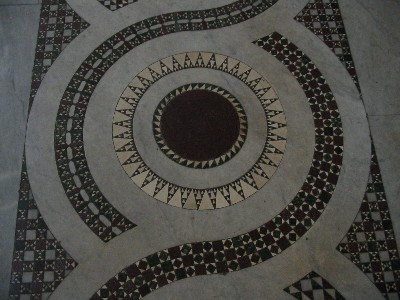 church in Rome, it contains all the artistic and architectural features required by the
liturgy of that time. And its untouched "Cosmatesque" pavement provides
the perfect opportunity to discuss the significance of its symbols and
local stonecutting techniques. After recharging in Santa
Maria’s quiet interior, we may pause momentarily under the
crowded porch of the church. Here is the famous Bocca della
Verita’, which—medieval lie-detecting legends to the
contrary—is a manhole cover from an ancient Roman sewer,
depicting Oceanus, the God of the Seas. church in Rome, it contains all the artistic and architectural features required by the
liturgy of that time. And its untouched "Cosmatesque" pavement provides
the perfect opportunity to discuss the significance of its symbols and
local stonecutting techniques. After recharging in Santa
Maria’s quiet interior, we may pause momentarily under the
crowded porch of the church. Here is the famous Bocca della
Verita’, which—medieval lie-detecting legends to the
contrary—is a manhole cover from an ancient Roman sewer,
depicting Oceanus, the God of the Seas.
Crossing the Tiber, we head to Santa Cecilia where the glittering of
early Medieval mosaics invites contemplation. Before them, a
baldachin—a masterpiece by Arnolfo di Cambio—stands over
the altar.
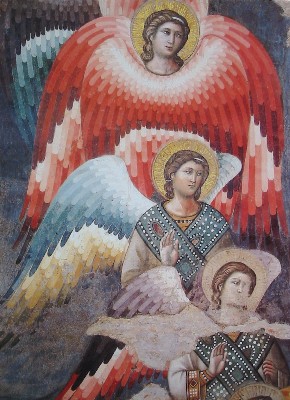 At the chorus on the second floor, we find Cavallini's frescoes
depicting the Last Judgment. This fragmentary masterpiece was covered
for centuries and considered lost by many. Recently rediscovered, it
has been open to the public for a very short period of time. A
delightful work, it provokes us to think about Rome's role in the
development of late Medieval-early Renaissance art and workshops.
At the chorus on the second floor, we find Cavallini's frescoes
depicting the Last Judgment. This fragmentary masterpiece was covered
for centuries and considered lost by many. Recently rediscovered, it
has been open to the public for a very short period of time. A
delightful work, it provokes us to think about Rome's role in the
development of late Medieval-early Renaissance art and workshops.
From here we stroll through Trastevere towards our next destination,
the church of Santa Maria in Trastevere. As we go, we get a feel for
the neighborhood in which Cavallini spent many years creating frescoes
and mosaics for his noble patrons. Comfortably seated in the church, we
examine two sets of mosaics. The first, in the apse, is by an anonymous
artist and his assistants. It depicts the Assumption and Coronation of
the Virgin.
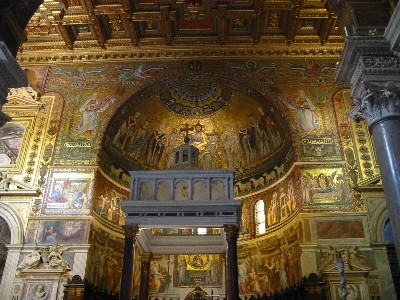 Completed
circa 1140 for Pope Innocent II, it subtly celebrates the deposition of
several heretics and the subsequent unification of the Church with her
celestial Bridegroom. Beneath the apse are six, masterful late-Medieval
mosaic panels composed by Cavallini, illustrating scenes from the life
of the Virgin Mary. Created for the Stefaneschi family in the 1290s,
these delightful illustrations reflect the impact of contemporary
Cosmatesque marble-work and the development of a new, more
"photographic" approach to artistic representation. Completed
circa 1140 for Pope Innocent II, it subtly celebrates the deposition of
several heretics and the subsequent unification of the Church with her
celestial Bridegroom. Beneath the apse are six, masterful late-Medieval
mosaic panels composed by Cavallini, illustrating scenes from the life
of the Virgin Mary. Created for the Stefaneschi family in the 1290s,
these delightful illustrations reflect the impact of contemporary
Cosmatesque marble-work and the development of a new, more
"photographic" approach to artistic representation.
|
