 |
|
|
|
|
|
Medieval Frescoes and Marble Intarsia Were the Middle Ages really so bleak? Did artists truly lack
inspiration and did the Arts stagnate? What did patrons want to express
when they commissioned artisans to decorate churches and chapels? What
did the cartoonish gestures in
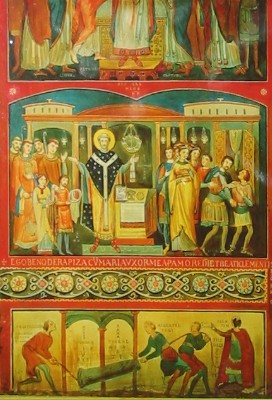
In the long-ago year 1000, in what is now the lower level of
San Clemente, Maria Macellaria and her consort commissioned
t≈hree frescoes dedicated to th
Although their exact identity is lost, rumors claim that the
saints
were four stonecutters or sculptors who were martyred on account of
their refusal to carve pagan idols after their conversion to
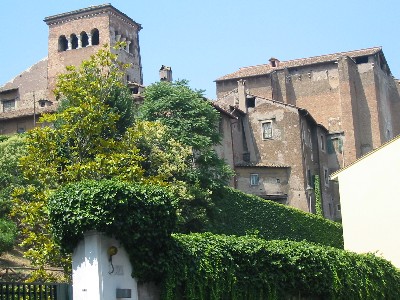
Christianity. The church of the Four Crowned Saints itself is a
peculiar remnant of medieval architecture, where sacred space vies with
fortress architecture. Indeed, during the turbulent years of the Middle
Ages, it served both purposes. Today, the structure is occupied by
cloistered nuns who will, with a donation, lend us the key to open the
door to Saint Sylvester's Chapel.
Saint Sylvester's Chapel is our second stop in this half-day
in order to appreciate the art in chronological order.
Returning to San Clemente, we will contemplate the fresco cycle of the famous Branda-Castiglione chapel from the early 1400s. Once attributed to the early Renaissance artist Masaccio, modern research now ascribes them Masolino da Panicale. On the side walls of the chapel, we observe scenes from the life of Saint Catherine of Alexandria and Saint Ambrose. On the back wall is a Crucifixion. In Masolino's masterpiece, the Renaissance desire to experiment with perspective, to accurately depict interior and exterior space, and to render figures in a life-like manner is more than apparent. After admiring this piece and studying it closely, we come to appreciate the passage from Medieval art to its early Renaissance successors. |
 medieval frescoes really mean
to onlookers? How did these gestures continue to manifest themselves in
Renaissance art? We will answer these questions as we
concentrate on the upper and lower levels of the church San Clemente
and the frescoes in the chapel of San Silvestro at the church of Santi
Quattro Coronati.
medieval frescoes really mean
to onlookers? How did these gestures continue to manifest themselves in
Renaissance art? We will answer these questions as we
concentrate on the upper and lower levels of the church San Clemente
and the frescoes in the chapel of San Silvestro at the church of Santi
Quattro Coronati.
 e life of Saint Clement and one scene in honor
of the popular Saint Alexis. The anonymous
artist(s) caught the Christian community's attention by using humorous
cartoon-style vignettes to illustrate lessons about miracles and
righteous living. After discussing these scenes, their content, and
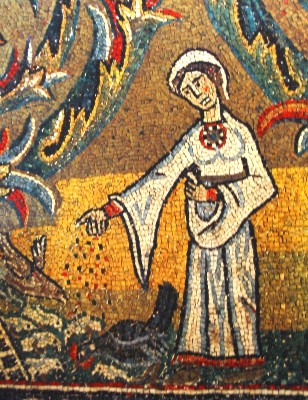
their style, we focus on the mosaics in the upper church’s
apse. After focusing on San Clemente, we head over to the
forgotten church of Santi Quattro Coronati, the Four Crowned Saints.
e life of Saint Clement and one scene in honor
of the popular Saint Alexis. The anonymous
artist(s) caught the Christian community's attention by using humorous
cartoon-style vignettes to illustrate lessons about miracles and
righteous living. After discussing these scenes, their content, and
their style, we focus on the mosaics in the upper church’s
apse. After focusing on San Clemente, we head over to the
forgotten church of Santi Quattro Coronati, the Four Crowned Saints.
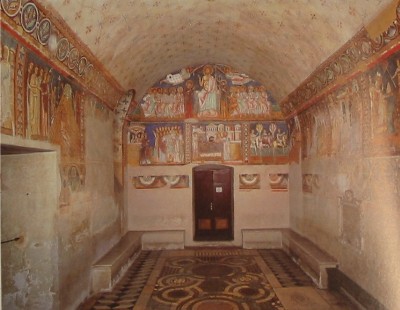 Although experts disagree on the exact date, the chapel was decorated
sometime in the mid-1200s. It is often described as a hymn to the
Emperor Constantine's generosity and magnanimity. With true medieval
flair, however, the fresco cycle focuses on Constantine's conversion by
and submission to Pope Sylvester. Full of historic inaccuracies, the
fresco is a marvelous work of Medieval art.
Although experts disagree on the exact date, the chapel was decorated
sometime in the mid-1200s. It is often described as a hymn to the
Emperor Constantine's generosity and magnanimity. With true medieval
flair, however, the fresco cycle focuses on Constantine's conversion by
and submission to Pope Sylvester. Full of historic inaccuracies, the
fresco is a marvelous work of Medieval art.