 |
|
|
|
|
This tour aims at resuscitating the Tiber’s
self-esteem. After all, it saved Romulus
and Remus (Rome’s founders), nurtured Rome in the first years of its existence,
was the driving force behind Rome's commercial success, and was a constant,
intimate presence in the life of Rome's inhabitants for hundreds of years—even after
the decline of the Rome Empire. The connection between Rome and its river was lost
in the modern era. The Muraglioni, the tall
stone embankments that flank it, are in part to blame. They were built in the early 1900s to prevent
flooding, which seemed like a good idea at the time... Italy had just been
united and Rome, the new country’s capital, could not continue being a victim
of the river's regular watery pranks. The
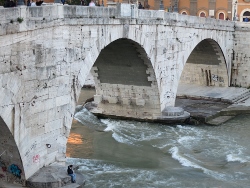
embankments, however, separated the city from its former life support system. We’ll go back in t Starting on Tiber Island, we discuss
several bridges, which are over two thousand years old and in perfect
condition. From the Island, we can
glimpse the Cloaca Maxima--the main drain of the ancient Roman sewer system
that ran under a large portion of the city, the Roman Forum included. Strolling through scenic Trastevere, we’ll
discuss place names and roads (like Vicolo della Renella and Via Arenula), which have to do
with the River. (Actually, both Renella
and Arenula come from “arena,” which Entrance fees: there are none, with the exception of Castel Sant'Angelo if visitors would like to add it to the itinerary.
Flumen Tiberis: The Tiber River is yours to discover!
 ime, long before the
embankments were built, to discover the original role of the Tiber. We’ll explore the long relationship between
the city and the river; how generations worked next to it and on it, transported
the goods of an empire, relaxed on its shores, and in later eras, ferried pilgrims eager to visit churches from one bank to another…
ime, long before the
embankments were built, to discover the original role of the Tiber. We’ll explore the long relationship between
the city and the river; how generations worked next to it and on it, transported
the goods of an empire, relaxed on its shores, and in later eras, ferried pilgrims eager to visit churches from one bank to another…  meant “sand” and referred to the sandy
approaches where locals went to bath or wash clothes.) We’ll cross Ponte Sisto once we’ve discussed the
bustling ancient harbors that hugged the banks of the Tiber – not to mention
the occupational hazards of some of the workers! Continuing upstream (to avoid the heavy
traffic of the Lungotevere), we’ll meander along the quiet Via Giulia, which
was the “in” place to live in the 1500s. (In fact, the artist Raphael owned
meant “sand” and referred to the sandy
approaches where locals went to bath or wash clothes.) We’ll cross Ponte Sisto once we’ve discussed the
bustling ancient harbors that hugged the banks of the Tiber – not to mention
the occupational hazards of some of the workers! Continuing upstream (to avoid the heavy
traffic of the Lungotevere), we’ll meander along the quiet Via Giulia, which
was the “in” place to live in the 1500s. (In fact, the artist Raphael owned 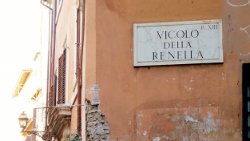 property there, rubbing elbows with
the most chic aristocratic families of his time…) We’ll examine a curious flood marker from the
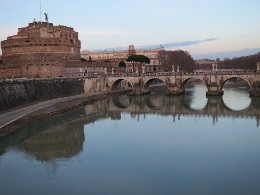
Middle Ages and then cross Ponte Sant'Angelo -- the bridge that Hadrian ordered
built in 130 A.D. to connect his Mausoleum with the central Rome.
property there, rubbing elbows with
the most chic aristocratic families of his time…) We’ll examine a curious flood marker from the
Middle Ages and then cross Ponte Sant'Angelo -- the bridge that Hadrian ordered
built in 130 A.D. to connect his Mausoleum with the central Rome.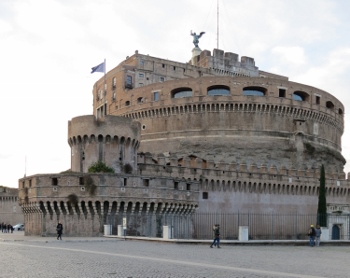 Energetic visitors will
opt to continue with Castel Sant'Angelo. The Angel Castle, which was built over the centuries but completed
mostly as one sees it today in the 1500s, is built on top of the Emperor
Hadrian's massive Mausoleum. The history
and symbolism of the Mausoleum is fascinating, while the artwork in the Castle
is top-notch. Don't forget the views
from the upper deck, which are not as good, but nearly rival those of Saint
Peter's Dome!
Energetic visitors will
opt to continue with Castel Sant'Angelo. The Angel Castle, which was built over the centuries but completed
mostly as one sees it today in the 1500s, is built on top of the Emperor
Hadrian's massive Mausoleum. The history
and symbolism of the Mausoleum is fascinating, while the artwork in the Castle
is top-notch. Don't forget the views
from the upper deck, which are not as good, but nearly rival those of Saint
Peter's Dome!
Note: Bring a camera because this itinerary will introduce you to some of Rome's most lovely side streets.