 |
|
|
|
|
|
LA FARNESINA: Chigi's "Villa Suburbana" Our story starts with Agostino Chigi. Born in 1466 to a
Sienese banking family, as a young man he launched his career in Rome,
quickly earning a fortune through intelligent investment strategies in
the world of high finance. Known in business circles as "il Magnifico,"
he was the richest man in Christendom during the reigns of Pope
Alexander VI (Borgia), Pope Julius II (della Rovere), and Leo X
(Medici). He reached the pinnacle of success, however, at a g
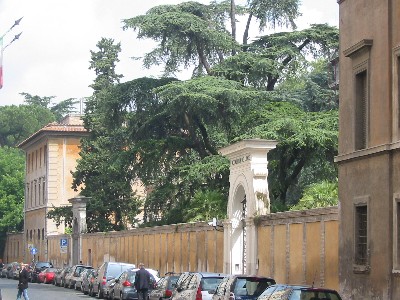
Following his doctor's advice, Chigi searched for land in the nearby Roman countryside where he could build a summer home—a retreat removed from the clamor of the city without being far from the call of duty . In those days, the "countryside" surrounded Rome's miniscule center and included land along the western bank of the Tiber where, 2000 years earlier, patrician Romans built their vacation homes. Cicero wrote about wanting to buy a villa in this area. Catullus' infamous lover, Clodia, owned property here. Even the Emperor Augustus' daughter, Julia, if in Rome during the long summer afternoons, would enjoy the breeze that wafted up the Tiber along the verdant western bank. And by the end of the 1st century AD, the gardens of Roman emperors dominated most of the area. Since the aristocracy of the Renaissance delighted in copying
antiquity, “il Magnifico” chose to situate his
villa where the ancient nobles passed their summers. Moreover, he hired
the famous architect, Baldassarre Peruzzi, to design his villa in the
style of Emperor Nero's Golden Home, which at that time had just been
rediscovered. This embrace of classical Roman style would revolutionize
architectural trends in summer homes and palaces for the next two
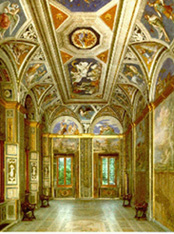
centuries. Artists were employed to revive classical pagan themes in
audacious full-scale frescoes. Gods and goddesses frolic; an entire
loggia is dedicated to the story of Cupid and Psyche; mythology is
reborn in high style
After Chigi’s death, his summer home was sold to the aristocratic Farnese family, who lived in the Palazzo Farnese on the opposite bank of the Tiber. Chigi’s estate was given the nickname "la Farnesina" (literally, “the little Farnese palace”) to distinguish it from the Farnese family's primary residence. The name stuck even after the property was sold and fell into disrepair. Luckily, in the late 1800s, the State bought the property and
embarked on a lengthy restoration process. When the Farnesina was
finally opened to the public in the 1900s, visitors were amazed by what
they saw. The Farnesina not only boasted fine art and architecture by
Peruzzi, it also contained Raphael's sea-nymph Galatea,
During a visit that usually lasts a little less than 3 hours, we cover Chigi's life in detail, discussing his financial success, his philanthropy, and his exuberant family life. After that, we examine the architectural style that inspired his home and other great villas to come. Then we step inside, appreciating some of the most outrageously personalized Renaissance art still visible in Rome. With a little time, patience, and imagination, the halls of the summer home slowly come alive with courtiers, languid poets, fine musicians, and an intrepid cardinal or two. And if we are lucky, Chigi's spirit, still wearing its bunny slippers and savoring a glass of white wine, will accompany us through his dream home's rooms. |
 reat cost to his health. Indeed, when Chigi
turned forty, his private physician hinted ominously that he had to
slow down "or else..."
reat cost to his health. Indeed, when Chigi
turned forty, his private physician hinted ominously that he had to
slow down "or else..."
 . In Chigi’s gardens, ancient statuary
lined flower-strewn walkways. An impromptu theater was set up for
viewing plays by ancient comedians like Plautus and Terrence. Chigi's
villa was a hymn to
. In Chigi’s gardens, ancient statuary
lined flower-strewn walkways. An impromptu theater was set up for
viewing plays by ancient comedians like Plautus and Terrence. Chigi's
villa was a hymn to 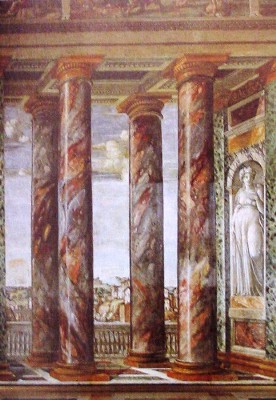 by Sodoma
(one of Raphael's boisterous retinue), a ribald frescoed ceiling
designed by Raphael and executed by Francesco Penni, Giulio Romano, and
Giovanni da Udine (Raphael's other close associates), and early works
by Sebastiano del Piombo (renowned as one of Michelangelo's few
disciples). This is one of the few places in Rome where so many great
names can be observed so closely in relative privacy.
by Sodoma
(one of Raphael's boisterous retinue), a ribald frescoed ceiling
designed by Raphael and executed by Francesco Penni, Giulio Romano, and
Giovanni da Udine (Raphael's other close associates), and early works
by Sebastiano del Piombo (renowned as one of Michelangelo's few
disciples). This is one of the few places in Rome where so many great
names can be observed so closely in relative privacy.