 |
|
|
|
|
|
Ancient Roman Urban Planning
Here we start our visit by going back to 800 B.C.,
approximately 50
years before Rome's foundation. We discover a natural harbor teeming
with Greek and Phoenician traders who, for the previous several hundred
years, had dominated the Mediterranean and earned their living through
commerce. As we discuss the foreign influences that shaped the emb
The natural harbor was used for centuries until it and the
neighborhood around it underwent a series of renovations. From 600 BC
on, the area was widely recognized as a commercial center, drawing
large crowds. Soon, the riverside was one long marketplace: the Forum
Boarium (the Cattle Market), the Forum Holitorium (the Vegetable
Market) and the Forum Piscatorium (the Fish Vendors) flanked one
another and thrived. After hunting down the remnants of these markets,
we will admire multiple temples that still line the
riverside—a small boardwalk of sanctuaries erected after
momentous battles. Further downstream, we will appreciate a temple,
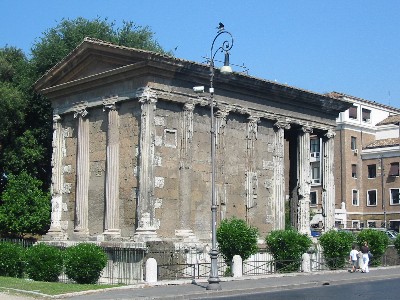
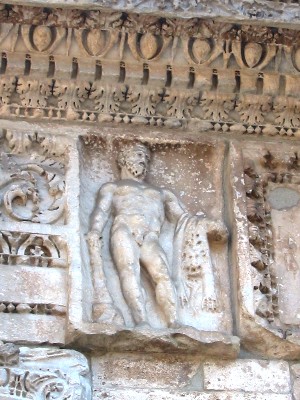
often wrongly referred to as the Temple of Vesta, erected by a wealthy
merchant and dedicated to Hercules. Originally noted for being the
second temple in the city erected and decorated with Grecian marble, it
is now the oldest existing marble temple standing in Rome.
Although the markets fed the city until the Age of the Republic, they were eventually dwarfed by the metropolis' growing needs. To avoid famine, corruption, and riots, local administrators decided to dismantle the old harbor and build a modern port with a sophisticated system of docks in the undeveloped plateau just downstream, where the neighborhood Testaccio now stands. Big businesses relocated, following the harbor and took advantage of grandiose new emporium, silos, warehouses and storage spaces. Clearly, one or two stores lingered so that Aunt Julia and
other locals could buy a bundle of chicory and a dozen eggs when the
need arose.
|
 Modern
Rome seems oblivious to the Tiber River, which divides the city neatly
in half. In fact, the river is often unfairly compared to an open
sewer, snaking between the Muraglioni, the towering white walls that
were built during the late 1800s and early 1900s in order to dam the
Tiber and prevent it from flooding. There was a time, however, when the
city depended on its river for both transportation and commerce.
Indeed, the city’s origins begin with the river, specifically
a
small inlet just downstream from Tiber Island.
Modern
Rome seems oblivious to the Tiber River, which divides the city neatly
in half. In fact, the river is often unfairly compared to an open
sewer, snaking between the Muraglioni, the towering white walls that
were built during the late 1800s and early 1900s in order to dam the
Tiber and prevent it from flooding. There was a time, however, when the
city depended on its river for both transportation and commerce.
Indeed, the city’s origins begin with the river, specifically
a
small inlet just downstream from Tiber Island.
 ryonic
city of Rome, we consider several passages of literature:
Virgil’s description of Greek Hercules' arrival on the banks
of
the Tiber; the settlement inaugurated by the psychic, Carmenta, and her
whiny Greek son, Evander; and the arrival of Bacchus' mother from the
east, tormented by the goddess Hera. The foreigners that
populate
these stories flocked to the banks of the Tiber from abroad or
accidentally washed up in its boat-friendly bay. Rome is not as Roman
as most people think!
ryonic
city of Rome, we consider several passages of literature:
Virgil’s description of Greek Hercules' arrival on the banks
of
the Tiber; the settlement inaugurated by the psychic, Carmenta, and her
whiny Greek son, Evander; and the arrival of Bacchus' mother from the
east, tormented by the goddess Hera. The foreigners that
populate
these stories flocked to the banks of the Tiber from abroad or
accidentally washed up in its boat-friendly bay. Rome is not as Roman
as most people think!

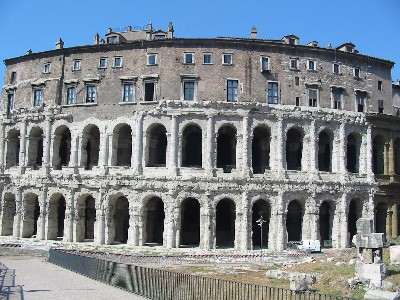 Otherwise, the zone became quaintly residential. Although
some real estate was left vacant, it did not take long for the State to
develop it. Toward the end of the Republic, Julius Caesar found this
site suitable for his theater, now known as the Theater of Marcellus. Nearby is another archeological gem, a classical
portico, reconstructed by Julius Caesar's adopted son, Octavian.
Standing to the side of his adopted father's theater, it once
surrounded two venerable Republican temples. The temples, and most of
the portico, have disappeared, but one magnificent central entrance
remains, waiting to be studied and admired.
Otherwise, the zone became quaintly residential. Although
some real estate was left vacant, it did not take long for the State to
develop it. Toward the end of the Republic, Julius Caesar found this
site suitable for his theater, now known as the Theater of Marcellus. Nearby is another archeological gem, a classical
portico, reconstructed by Julius Caesar's adopted son, Octavian.
Standing to the side of his adopted father's theater, it once
surrounded two venerable Republican temples. The temples, and most of
the portico, have disappeared, but one magnificent central entrance
remains, waiting to be studied and admired.