 |
|
|
|
|
|
The Barberini and Borghese Families
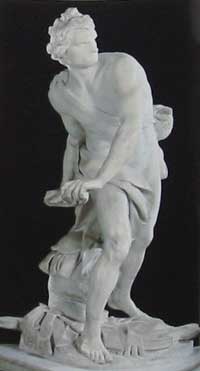
From approximately 1615 to 1624, Bernini continued to hone his art. He produced four, full-sized sculptures for the discerning Scipione Borghese. These sculptures, still in the Borghese collection, culminate in Bernini's version of David, seen here. Not only the hero and liberator of the Jewish state, David was often considered the patron saint of poets and artists because he composed the Old Testament Psalms. It should not surprise us then that this masterpiece of grimacing tension is actually Bernini's self-portrait. His friend, Maffeo Barberini is said to have held a mirror for the artist in his studio as he worked. (In 1624, Bernini suspended his activity as a sculptor, having been named Head Architect at the Church of Saint Peter's by Barberini, who had become Pope Urbanus VIII.)
If time and energy allow, we'll visit the famous Capuchin Church, which is near the Borghese Gallery. While Maffeo Barberini's brother was head of the church, work began on the elaborate construction of its eerie crypt, which was decorated entirely by the bones of long-deceased Capuchin friars. Human bones of all types cover room after room of the crypt, creating chandeliers, designs and dioramas that would be fanciful if they were not so chilling. A memento mori that serves as a baroque interpretation of death, the crypt is now notorious throughout the world and open to the curious and brave. |
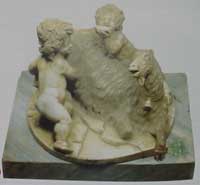 Cardinal Maffeo Barberini (later Pope Urbanus VIII) lived next door to Scipione Borghese, Pope Paul V's Cardinal nephew. ("Next door" in this case means the two possessed sprawling estates surrounded by gardens whose boundaries happened to meet.) Maffeo, who was on good terms with the avid art collector Scipione, instroduced him to a young sculptor, GianLorenzo Bernini. Scipione thought that Bernini had talent and flattered the young artist by buying one of his first works, a statue of the she-goat Amalthea. Although a bit rough, this statue foretells Bernini's mature techniques and his sensual ability to tantalize the viewer's five senses.
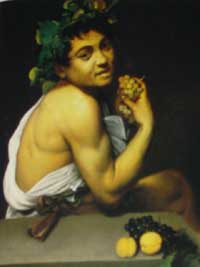 In the Galleria Borghese, at the heart of the Borghese Gardens, we will enjoy the magnificent art of Scipione's collection. After examining four stunning sculptures, several busts, and a variety of small models by Bernini, we will admire Scipione's superb collection of Caravaggios. These oil paintings, on display in one room, neatly trace Caravaggio's growth as an artist. Absorbing his work in chronological order, we begin with his early pieces: a still life and The Sick Bacchus. After examining his controversial rendition of the Virgin Mary, his renowned Saint Jerome, and his portrayal of Saint John the Baptist, our visit culminates with Caravaggio's spectacularly grim self-portrait, David and Goliath.